


Nobody decides to stop thinking. It happens one reasonable shortcut at a time.
A draft arrives from an AI tool. It reads well, the structure is clean, and the numbers look plausible. You skim it, change a word, and send it. The next time, you skim faster. Eventually you aren’t reviewing the work at all. You’re passing it along.
That’s AI Compliance Drift.
Verification doesn’t vanish in one moment. It moves through four phases: Rigorous, Selective, Occasional, and Absent. Each step feels sensible on its own, which is why most people never see the slide.
A related pattern has been measured in creative work. Doshi and Hauser, in a Science Advances study, gave some writers story ideas from a large language model. Those stories were rated more creative, yet they converged on a narrower range of ideas than stories written without AI. The authors describe a social dilemma: each writer does better, and the group gets less variety. The same pull can operate on leadership teams. When everyone starts from the same clean draft, the room loses the friction that catches mistakes.
The problem isn’t the tool. Nobody made a decision about where the check should live.
Two questions to ask every time
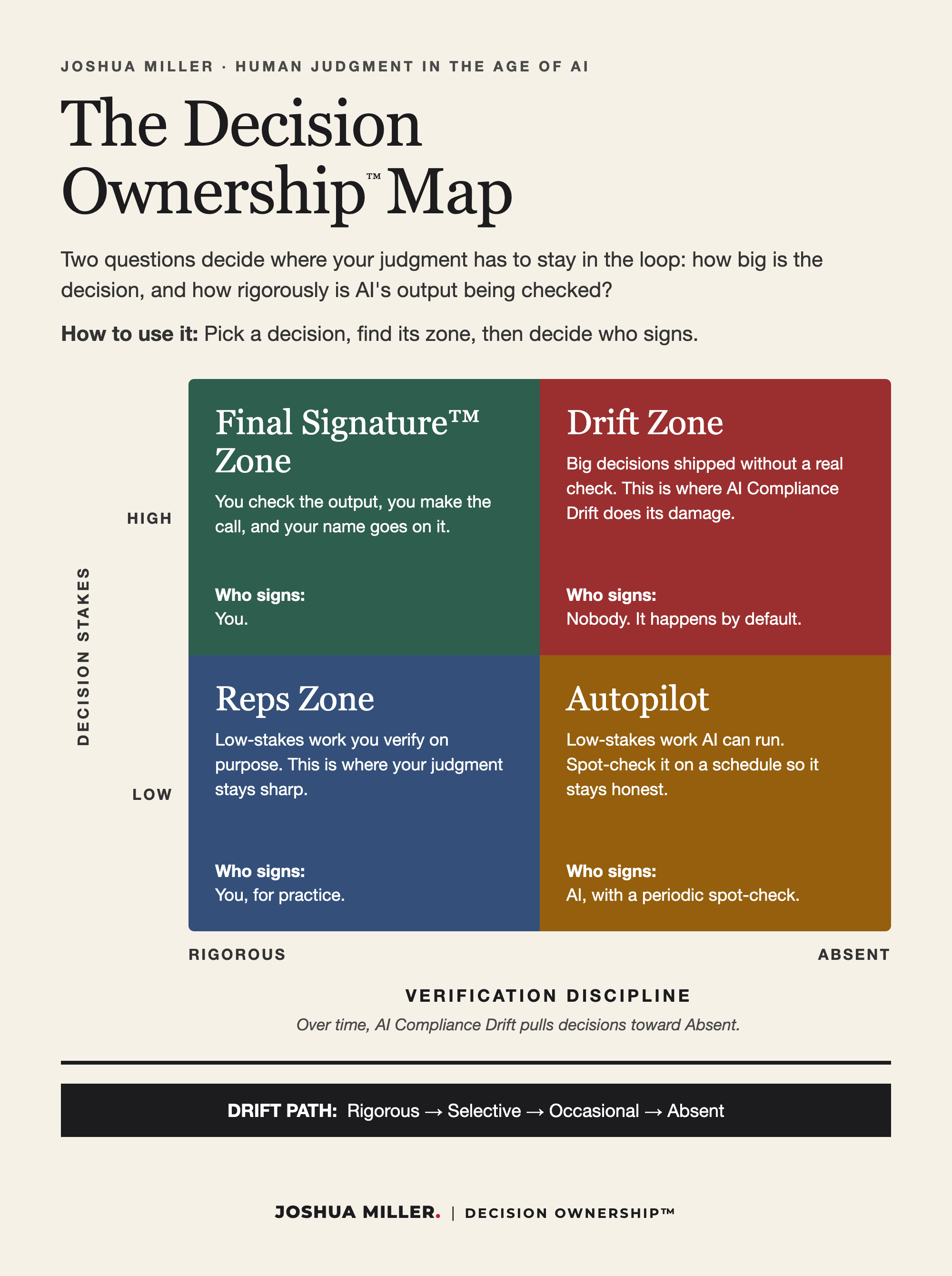
Use a simple map with two questions:
How big is the decision? If it’s wrong, who pays, and how much?
How rigorously is the output checked? Is someone verifying it, or has the check quietly gone?
Put those together, and you get four zones:
Drift Zone: big decisions with no real check. Nobody signs, and that’s the danger.
Final Signature™ Zone: big decisions you verify, decide, and own. Your name goes on it.
Autopilot: low-stakes work AI can run, with a periodic spot-check so it stays honest.
Reps Zone: low-stakes work you verify on purpose, because that’s where judgment stays sharp.
Why the Reps Zone matters
Judgment is a skill, and skills fade when you don’t use them. If AI handles every draft and you never check one on purpose, you lose more than a review. You lose the ability to notice when a review matters. That’s Cognitive Atrophy: the skill fades quietly while the output still looks fine.
So keep practice on the calendar. Pick one low-stakes piece of work each week and verify it yourself before you accept it.
Ownership, one decision at a time
Ownership isn’t a grand philosophy. It’s a small habit. Before you send, approve, or commit, ask one question: could I defend this without the tool open? If you can’t, you haven’t made the decision yet. You’ve let it happen.
Decision Ownership™ is the choice to keep your name on the work that matters. AI can draft it. It shouldn’t be the one who signs.
Lead what AI can’t.