


In this issue:
→ Why organizations are training for the wrong shortage
→ The skill everyone assumes people have, and fewer people do
→ One development shift for future-ready teams
Every organization is racing to close the AI skills gap. Prompt training. Tool certifications. Adoption dashboards.
Necessary. And aimed at the wrong shortage.
The World Economic Forum’s Future of Jobs research puts analytical thinking, not AI proficiency, at the top of the core skills list, with 44% of workers facing skills disruption by 2027 and six in ten needing training.
The tools change every quarter. The thinking underneath them is what employers can’t find.
The subtle shift
AI skills and thinking skills look similar on the surface. They diverge underneath:
→ AI skills: getting better output from the tool
→ Thinking skills: knowing whether the output is any good
The first is trainable in a workshop. The second requires practice.
The hidden risk
Organizations are producing a generation of leaders fluent in tools and untested in judgment.
When the tools fail, hallucinate, or simply face a problem outside their patterns, there’s no thinking bench behind them. The skill gap arrives precisely when it’s most expensive to close.
The leadership shift
Train the tools. Absolutely. But treat thinking as a first-class development priority with the same budget seriousness.
Because the tools are the same at every competitor. The thinking isn’t.
THE DEVELOPMENT SPLIT
Pull up your team’s actual development plan or last year’s L&D spend. Not what you intend. What’s funded. Twenty minutes.
Step 1. List every learning investment from the last twelve months. Courses, certifications, workshops, coaching, conferences, licenses. Include informal time if you track it.
Step 2. Sort each into one of three columns.
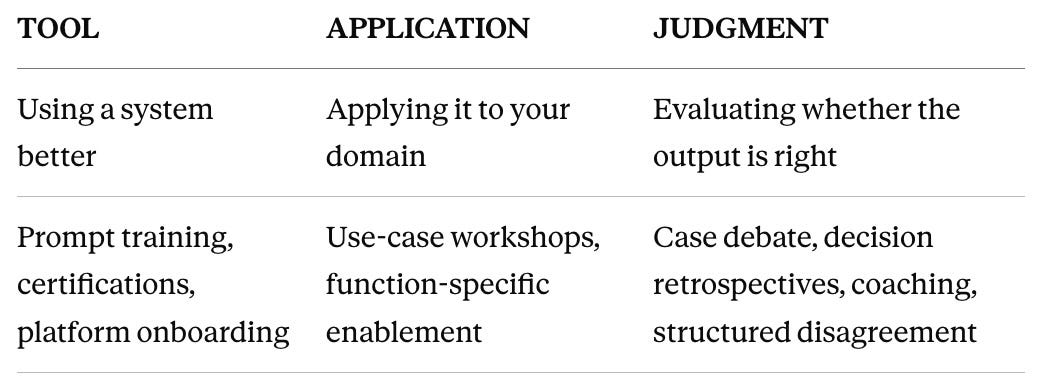
Step 3. Total the spend in each column.
What the split tells you
Most organizations land 70/25/5. Seventy percent tool, twenty-five application, five judgment. Often the judgment column is empty and the five percent is a leadership offsite that happened to include a hard conversation.
The tool column has a half-life. Every dollar there depreciates on the vendor’s release schedule. Prompt training from eighteen months ago is already partly obsolete.
The judgment column doesn’t depreciate. A leader who can evaluate an output can evaluate the next one, and the one after that.
The honest test: if your entire AI stack were replaced next year with something structurally different, what percentage of last year’s spend would still be paying off?
Where to move one line item
You don’t need to restructure the budget. Move one thing.
→ The cheapest high-value swap: add a thinking practice to training you’re already running. Solve the problem unassisted first, then with the tool, then compare. Costs nothing but sequencing.
→ Promote one thinking behavior publicly this month. Reward the person who challenged an output, not just the one who used the tool fastest. What gets recognized gets repeated, and right now speed is the only thing visible.
→ Name one non-tool line item for next year’s budget. Judgment development doesn’t get funded because nobody asks for it. Ask.
Question of the week: If I audited my team’s development plan, would it produce better AI users or better thinkers?
Before AI reshapes your organization, make sure it isn’t reshaping your ability to think.
The Human Intelligence Assessment is free and takes about ten minutes. It measures the three capabilities AI cannot replace: Awareness, Adaptability, Authenticity.
→ Take the free Human Intelligence Assessment
Teaching this live: the AI-Proof Review Kit, a four-hour Maven workshop on Dec 8, 10am to 2pm CST.
Lead what AI can’t.
JoshHMiller.com